
CXNexus — Desktop GUI for ConnectX Nodes
Desktop GUI for ConnectX nodes. Manage peers, networks, and node identity, with CXChat built in: decentralized P2P messaging with hybrid signed or E2E encrypted delivery.
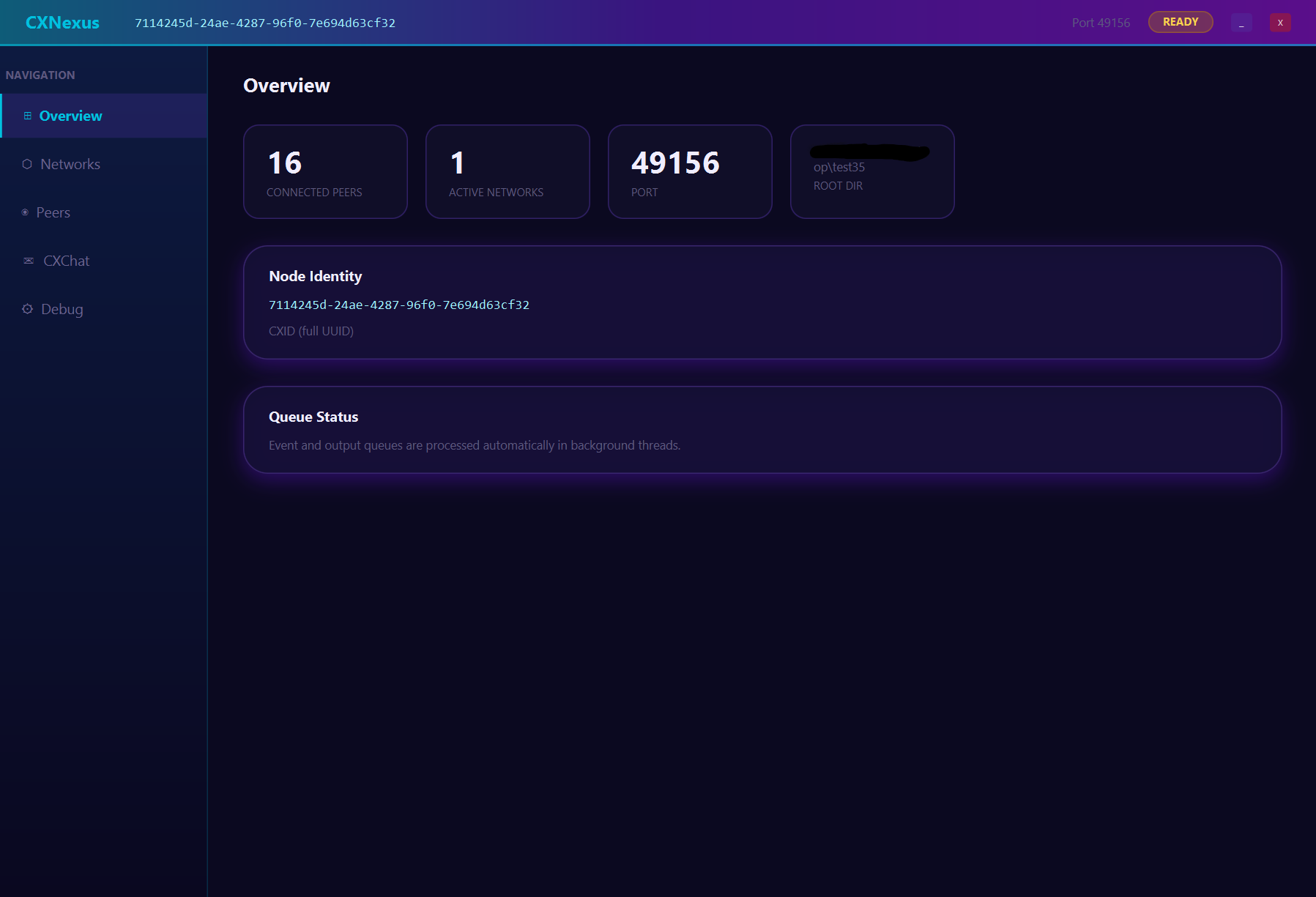
Overview: live node status, connected peers, active networks
Still a preview. 1.1.0 resolves the connectivity and join failures that made 1.0.0 hard to use, but CXNexus tracks a development build of ConnectX and features may still change without notice. Not recommended for production or critical use. The underlying ConnectX protocol remains in active development.
CXNexus 1.1.1
Windows installer. CXNexus ships with ConnectX 0.6.3 bundled, so no separate node installation is required. Upgrading is recommended for all installs: 1.1.1 bundles a security-hardened ConnectX build. See below for details.
CXNexus-1.1.1.msi · Windows 10/11 x64 · Bundles ConnectX 0.6.3
What's New in 1.1.1
1.1.1 bundles ConnectX 0.6.3, which completes a scoped internal security audit and tightens administrative authorization checks, alongside a new bounded dispatcher for CXApp handlers. No CXNexus-side UI changes accompany this release; upgrading is recommended for the bundled security work alone.
1.1.0 - Stability
1.1.0 is primarily a stability release. The headline problem in 1.0.0 was that joining a network frequently did nothing at all, with no error reported. That turned out to be several distinct faults in the underlying ConnectX seed exchange, all of which are fixed in the bundled 0.6.2 build.
- FixedCXChat now joins reliably. A network could not be joined unless three separate peers answered the seed request. On a small network too few peers could answer, so the join sat waiting forever with nothing logged. Cosigned network blobs prove themselves through their own signature chain, so a relayed blob is now applied on sight regardless of who forwarded it. The relaunch-and-rejoin workaround is no longer needed.
- FixedJoins no longer report false success. A seed signed before a network existed verified correctly but contained nothing relevant, so the join was marked complete while the network was never actually registered. Success now requires the target network to be present afterwards.
- FixedNetworks other than CXNET can be seeded properly. Seed responses now carry the cosigned network blob, so any peer holding a stored copy can serve a join, rather than the request only working when the responder's bootstrap happened to bundle that network.
- FixedRunning your own network works. A node could not verify a signature it had produced itself, which broke any node acting as Network Master Identity for its own network. The node's own key is now cached at startup.
- FixedMalformed seed traffic no longer misroutes. Unreadable seed requests and responses silently defaulted to CXNET, answering with the wrong network's seed and stranding whatever join was actually pending. Both sides now log and drop instead of guessing.
- NewNetworks page. Join or create a network at any time after onboarding, using the same flow as first-run setup. Tracked networks are listed with live state and per-network configuration.
- NewPeers page. A full peer directory with short ID, full CXID, advertised address, and last-signed timestamp. Resolve Peer by CXID asks EPOCH and known peers for a cosigned identity when this node has not met the peer directly.
- NewDebug panel. Queue diagnostics across job, event, output, retry, and pending-lookup queues; per-peer transport mode and route selection; manual CXHELLO, PeerFinding, and SeedRequest triggers; per-network CXN broadcast and direct send; and a live correlated event log.
- NewJoin progress screen. Joining now shows what it is actually waiting on, and offers a skip when a peer is unreachable, instead of hanging silently.
- ImprovedStale traffic is bounded. Per-event-type TTL and retry limits are now enforced, so an unanswered seed request is dropped in about a minute and reissued, rather than being retransmitted across the mesh for hours.
- ImprovedCorruption hardening. Power loss or file corruption during a write now generates a scoped recovery file and locks the affected core file from regeneration until it is acknowledged.
What is CXNexus
CXNexus is the desktop client for ConnectX. It bundles ConnectX 0.6.3 directly, so no separate node installation is needed. It gives you a live view of your node's state, connected peers, active networks, and message history.
It ships with CXChat: a decentralized peer-to-peer messaging client running over ConnectX's cryptographic pipeline. Every message is signed or end-to-end encrypted. No central server, no relay, no account registration.
What's Inside
Live Overview
Real-time view of connected peers, active networks, listening port, root directory, and node identity (CXID). Queue status for event and output threads.
CXChat
Decentralized P2P messaging over ConnectX. Hybrid mode: signed messages for attribution or full E2E encryption for privacy. No server, no registration.
Networks
Join an existing ConnectX network via Network ID or .cxn file, or create a new network as NMI, at any point rather than only at first run. Tracked networks are listed with live state and per-network configuration.
Peer Directory
Full peer table with short ID, complete CXID, advertised address, and last-signed timestamp. Resolve an unmet peer by CXID through EPOCH and known peers, with verified entries added on resolution.
Debug Panel
Queue diagnostics, per-peer transport mode and routing, manual CXHELLO / PeerFinding / SeedRequest triggers, per-network broadcast and direct send, and a live correlated event log.
Load or Create Nodes
Load an existing CXNode from disk with decryption key, or provision a new one. Client ID is auto-detected from key.cx. Port configurable at startup.
Decentralized Messaging
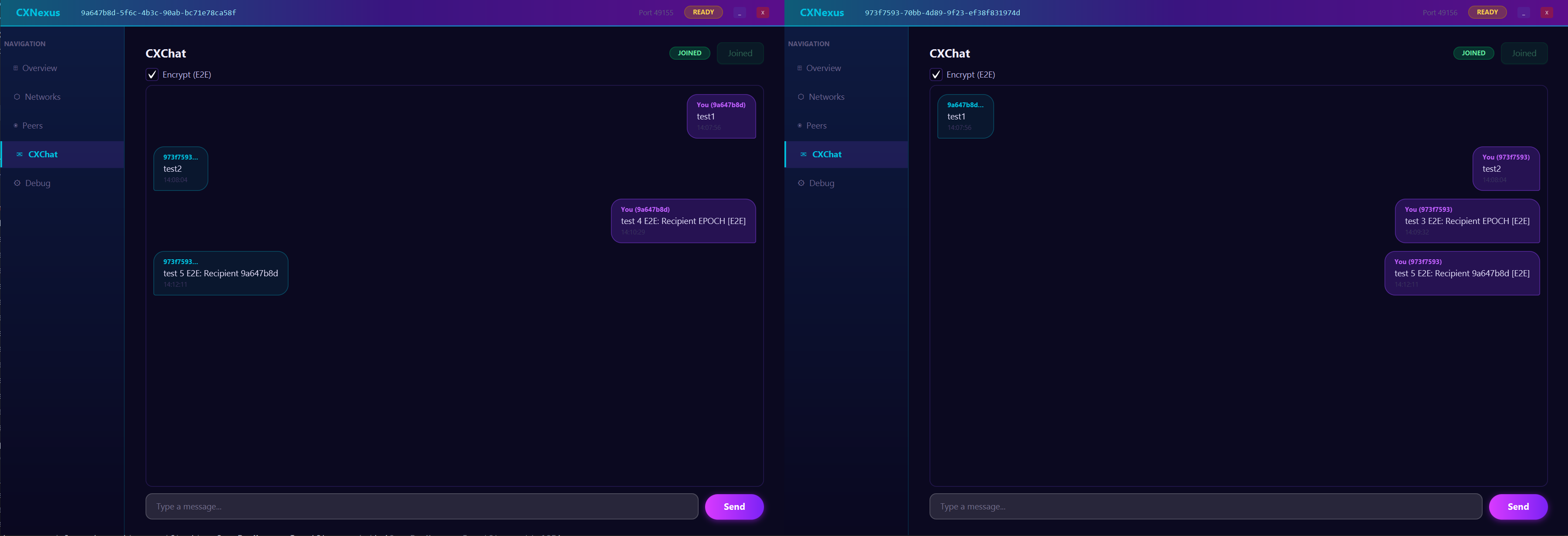
Two nodes exchanging E2E encrypted messages peer-to-peer, both joined
CXChat is built into CXNexus. Messages travel directly between peers over the ConnectX mesh, processed through the same five-stage cryptographic pipeline as all other ConnectX traffic.
Hybrid messaging: signed messages carry cryptographic attribution so recipients can verify the sender, or tick Encrypt (E2E) for private delivery addressed to a specific recipient. No central server, no relay. Joining CXChat connects your node to the CXChat network directly.
In 1.0.0 this join often failed silently, and the workaround was to relaunch and join manually at the startup prompt. That is fixed in 1.1.0: the join completes on first launch, and the panel shows a live JOINED state once the network is registered.
Join or Create a Network, Any Time
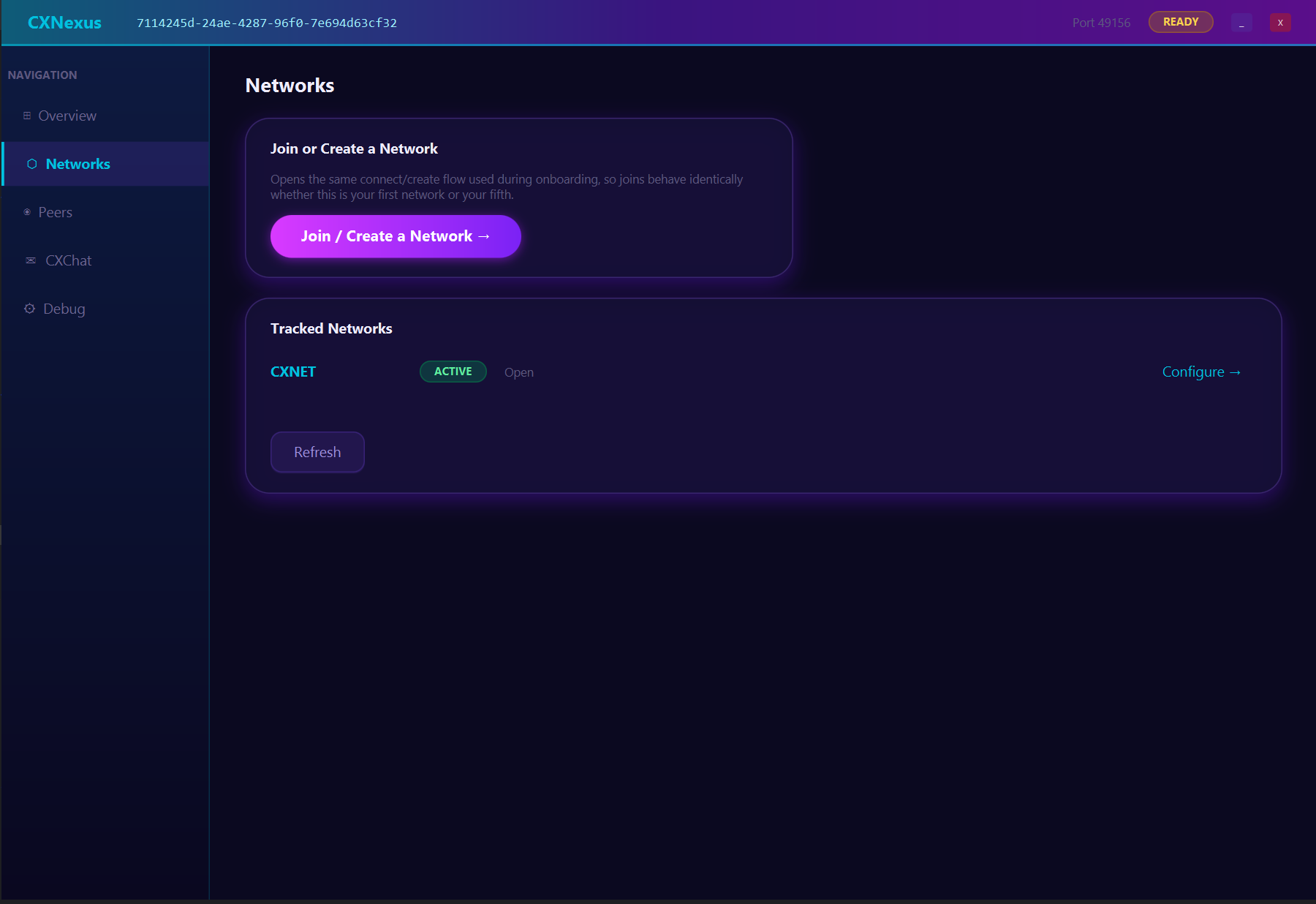
Networks: tracked networks with live state and per-network configuration
1.1.0 adds a dedicated Networks page. The join and create flow is no longer confined to first-run onboarding; it opens the same wizard, so a join behaves identically whether it is your first network or your fifth. Tracked networks are listed with their current state and open/private policy.
Joining validates the target network (Network ID, creation date, peer count, private flag, internal and external signature verification) before committing. Creating a new network provisions you as the Network Master Identity (NMI) with full permission control.
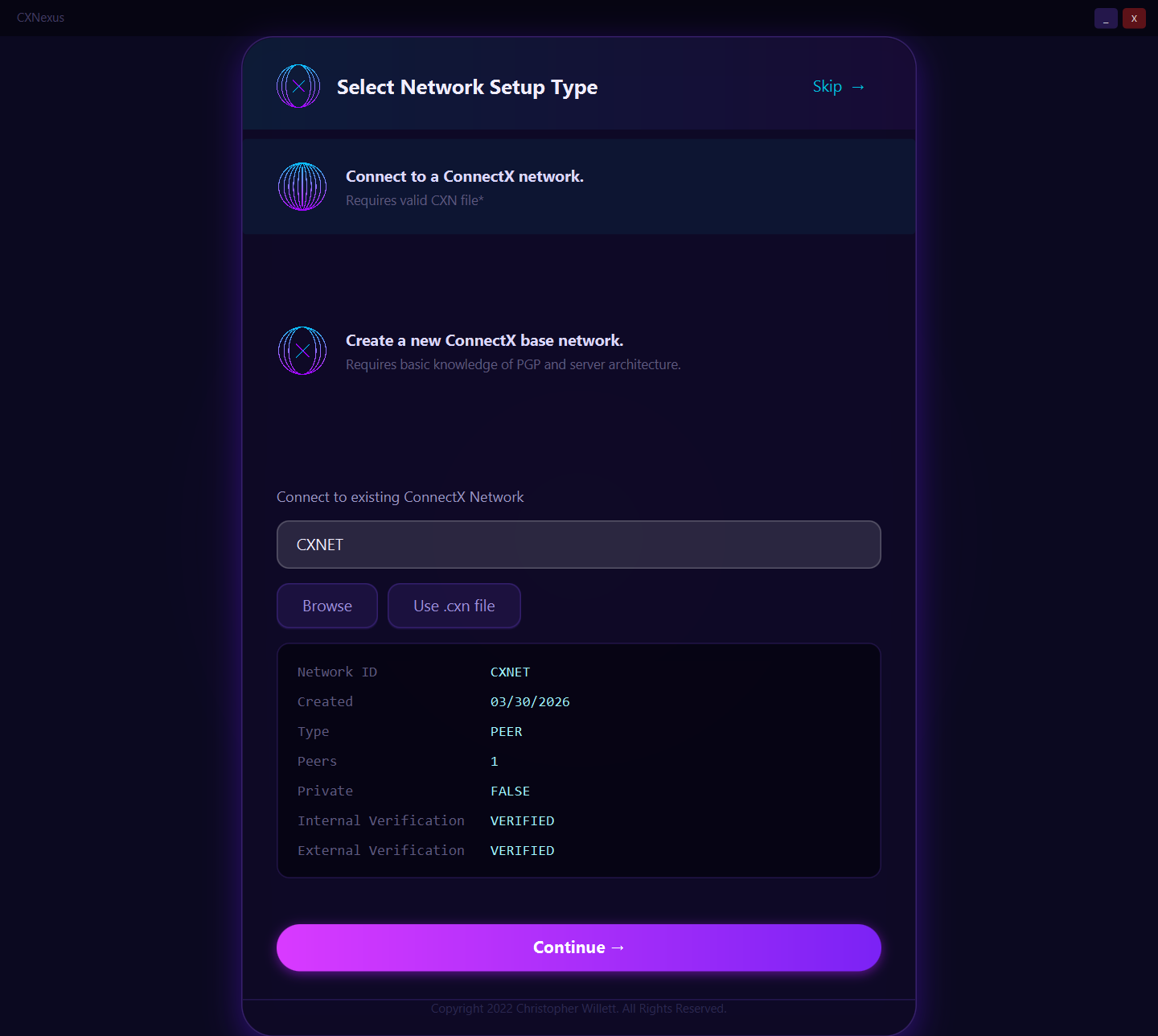
Join existing network, verified before connecting
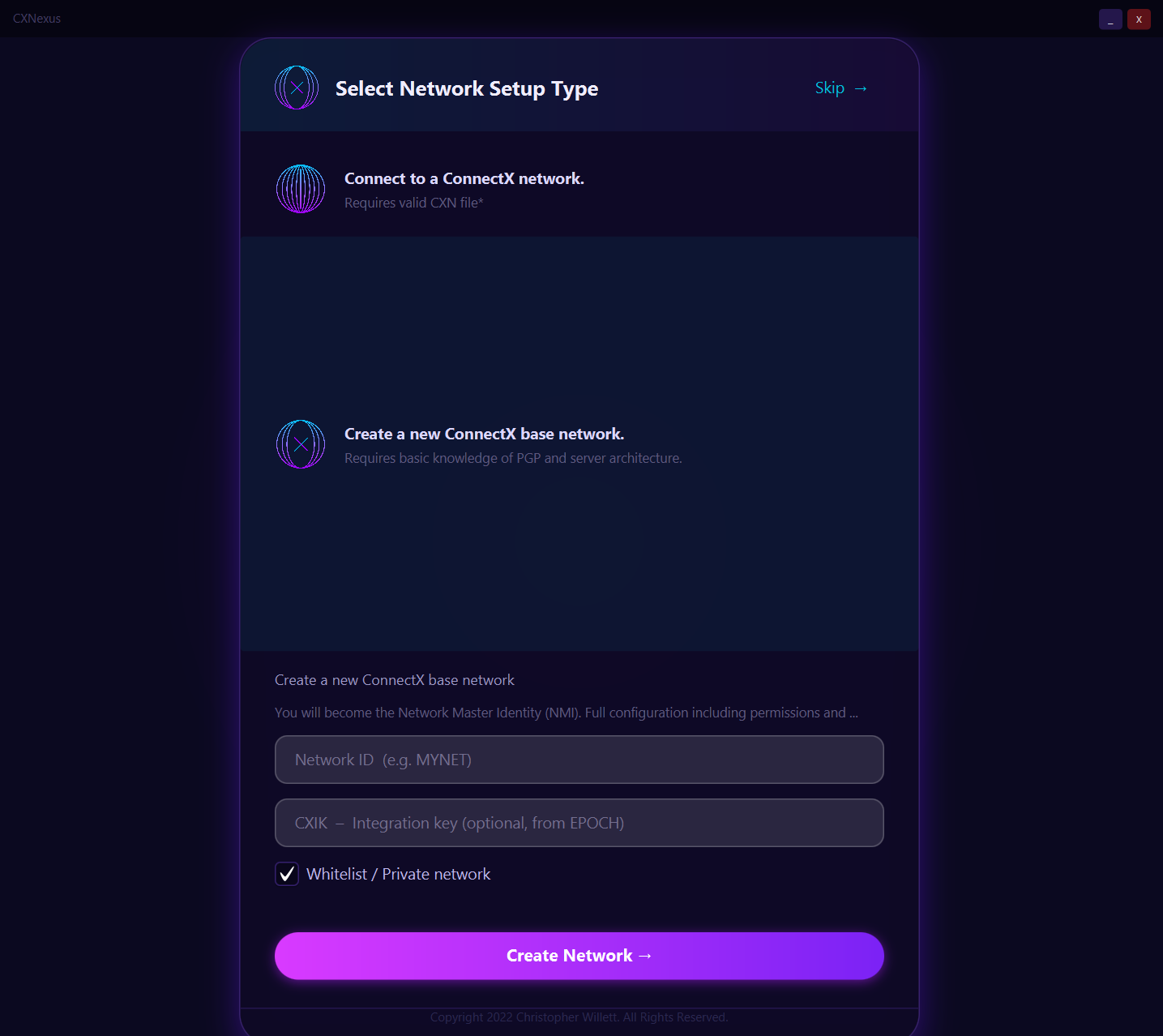
Create new network, become NMI, set whitelist policy
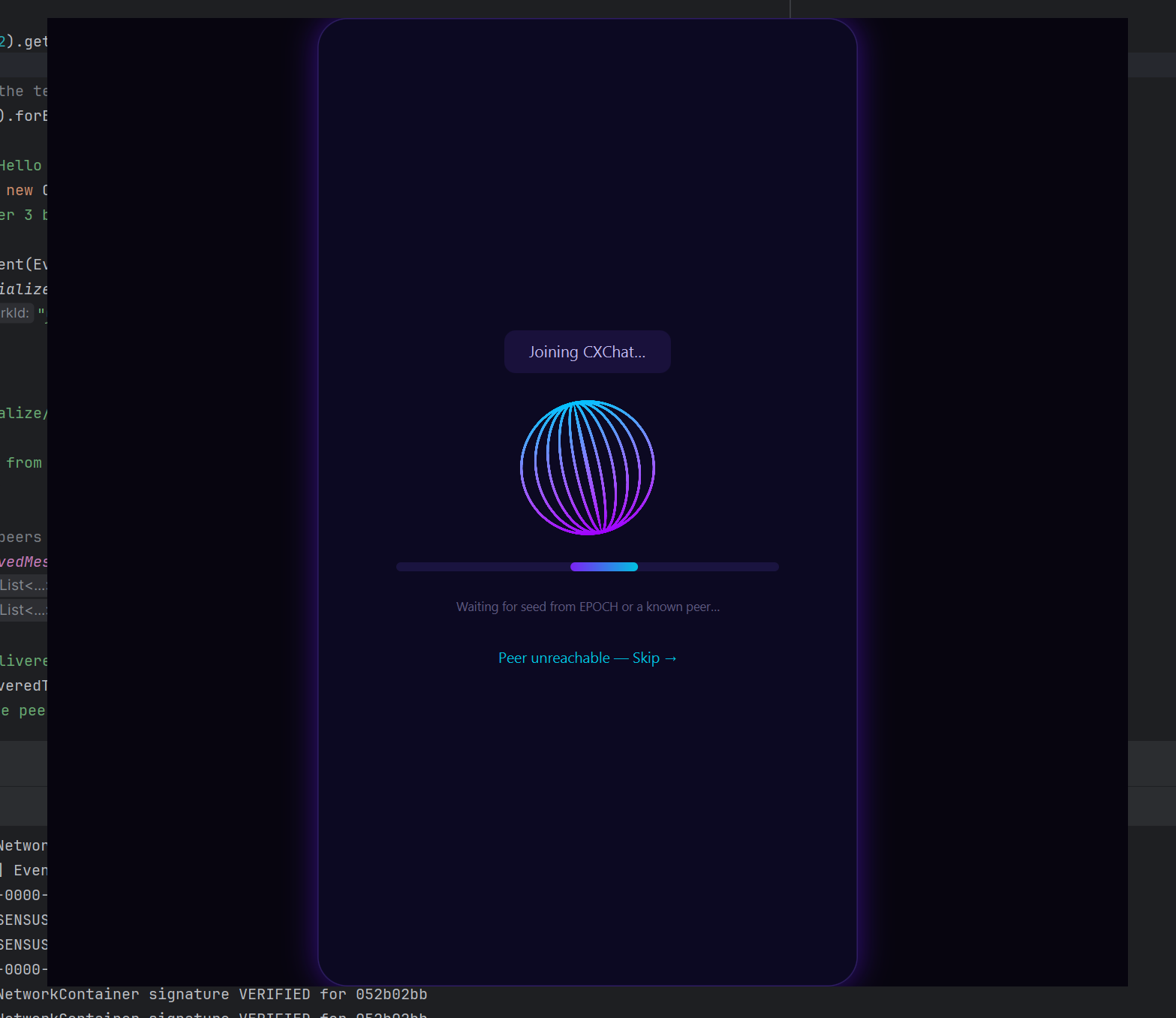
Join progress reports what it is waiting on, and offers a skip if a peer is unreachable
Peer Directory
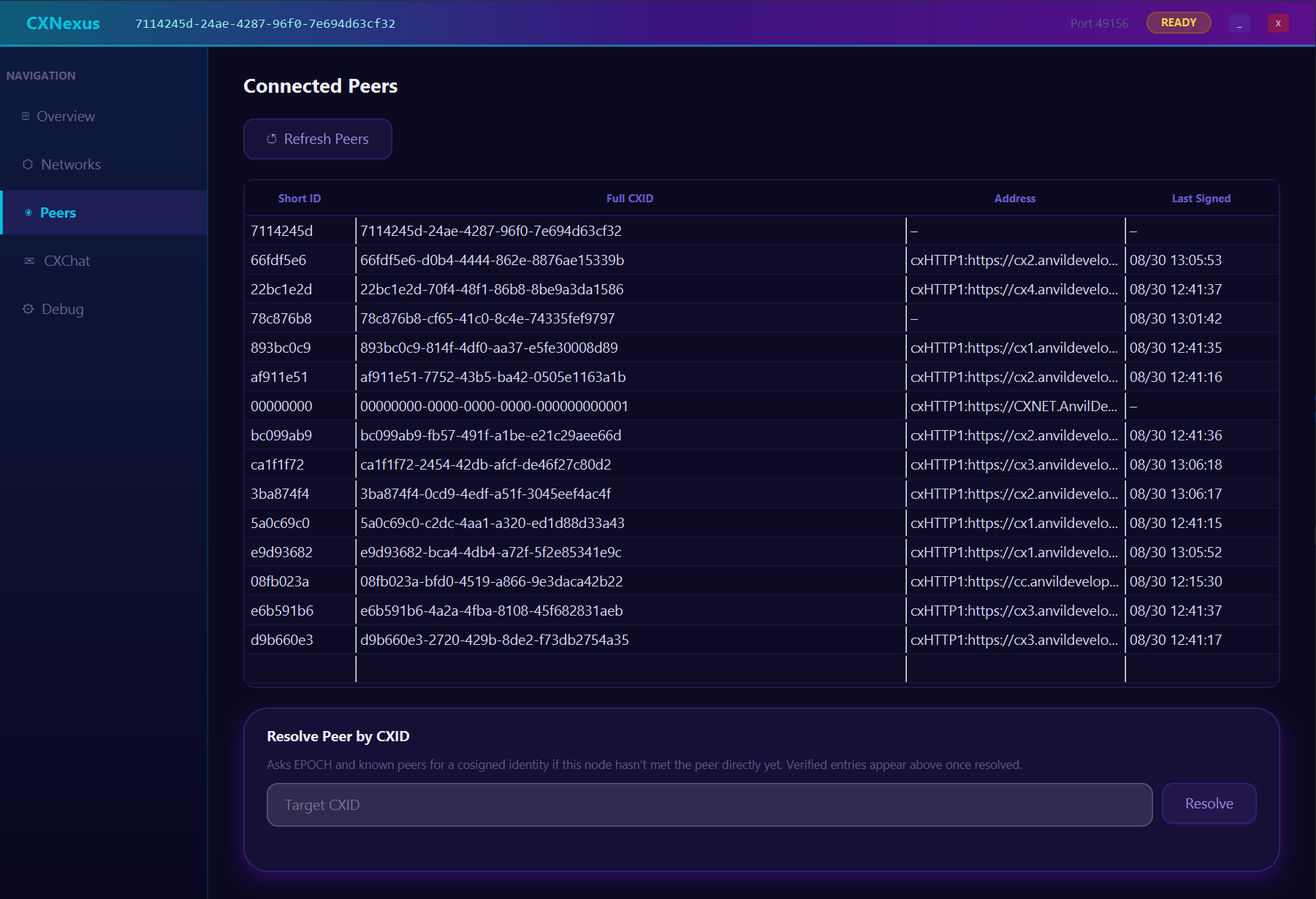
Connected peers with full CXID, advertised address, and last-signed time
The Peers page lists every peer this node knows about, with its short ID, full CXID, advertised address, and the time it last produced a verified signature. The address column is whatever the peer chooses to advertise: a cxHTTP1 bridge endpoint for nodes reachable through the HTTP bridge, or nothing at all for nodes that would rather not publish an IP. An empty entry is a deliberate choice by that peer, not a missing or broken record.
Resolve Peer by CXID handles the case where you know an identity but have never met it. CXNexus asks EPOCH and known peers for a cosigned identity, and the verified entry appears in the table once resolved.
Node Login
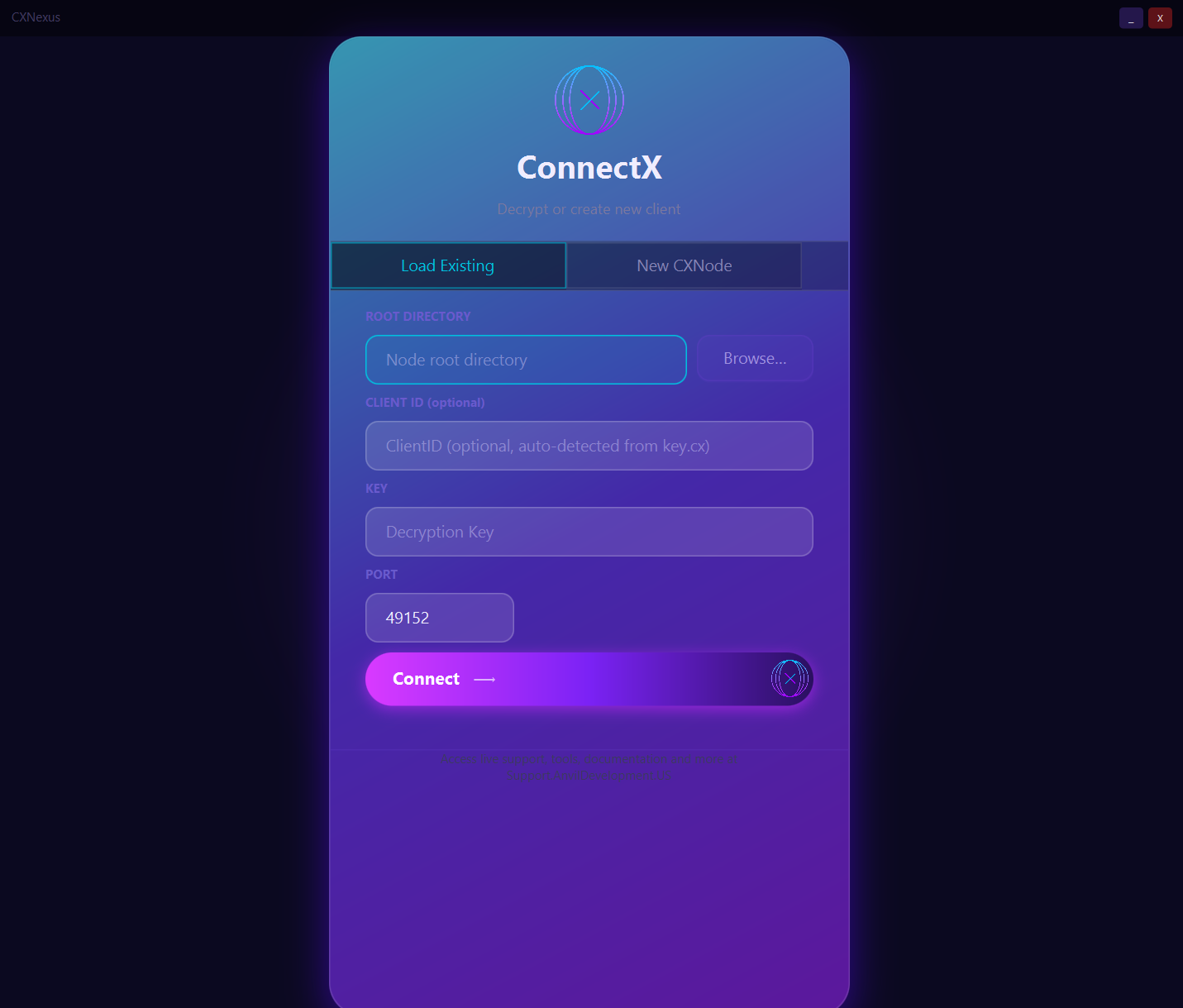
Load existing node or provision a new CXNode
At startup, load an existing node from its root directory with decryption key, or create a new CXNode. Client ID is auto-detected from the local key file. Port defaults to 49152.
Debug Panel
The debug panel is substantially expanded in 1.1.0. Queue diagnostics cover the job, event, output, retry, and pending-lookup queues, so a backlog is visible rather than inferred. Each known peer exposes its mesh and local reachability state, network membership, transport mode and route selection, and manual CXHELLO, PeerFinding, and SeedRequest triggers.
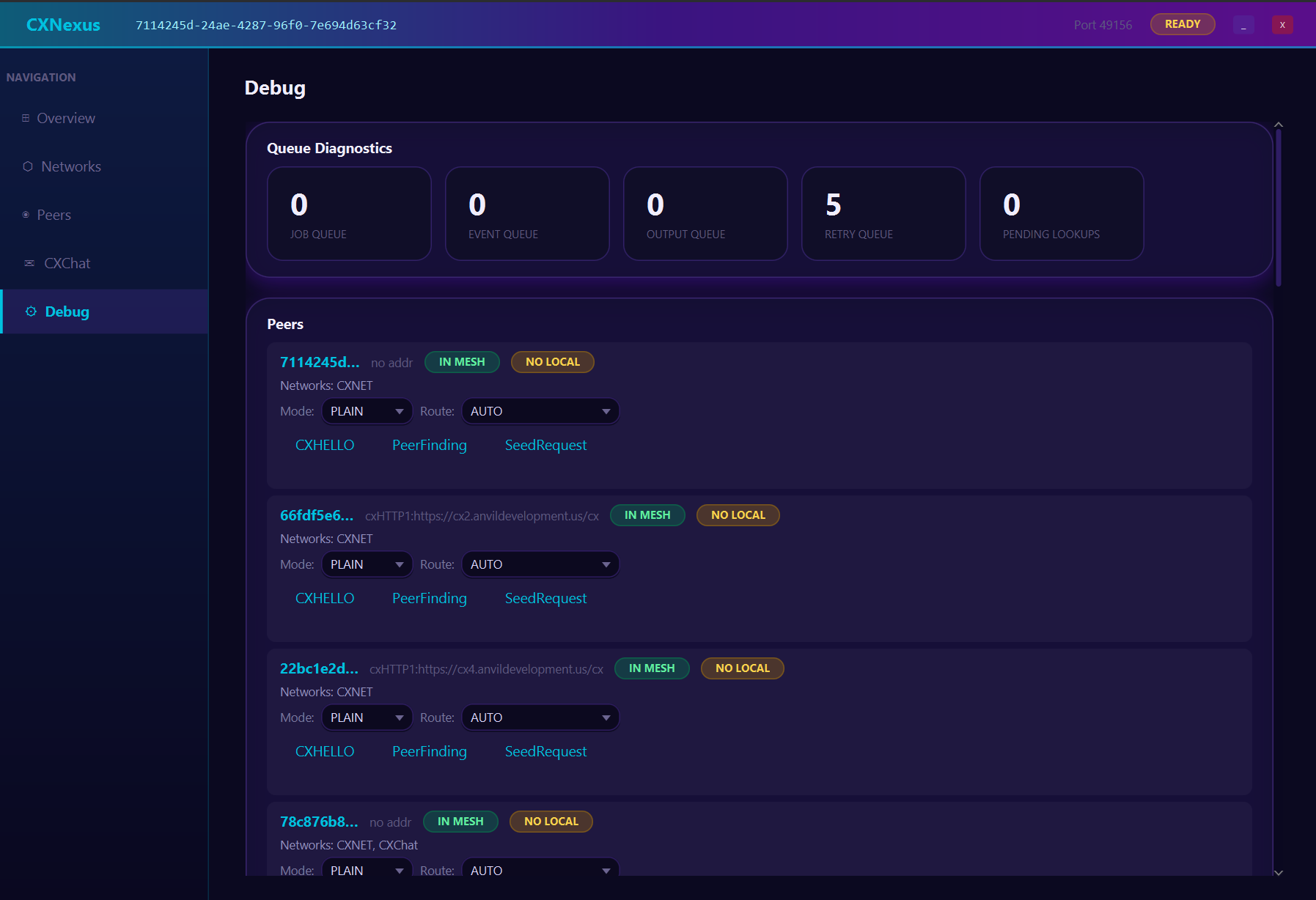
Queue diagnostics and per-peer transport controls
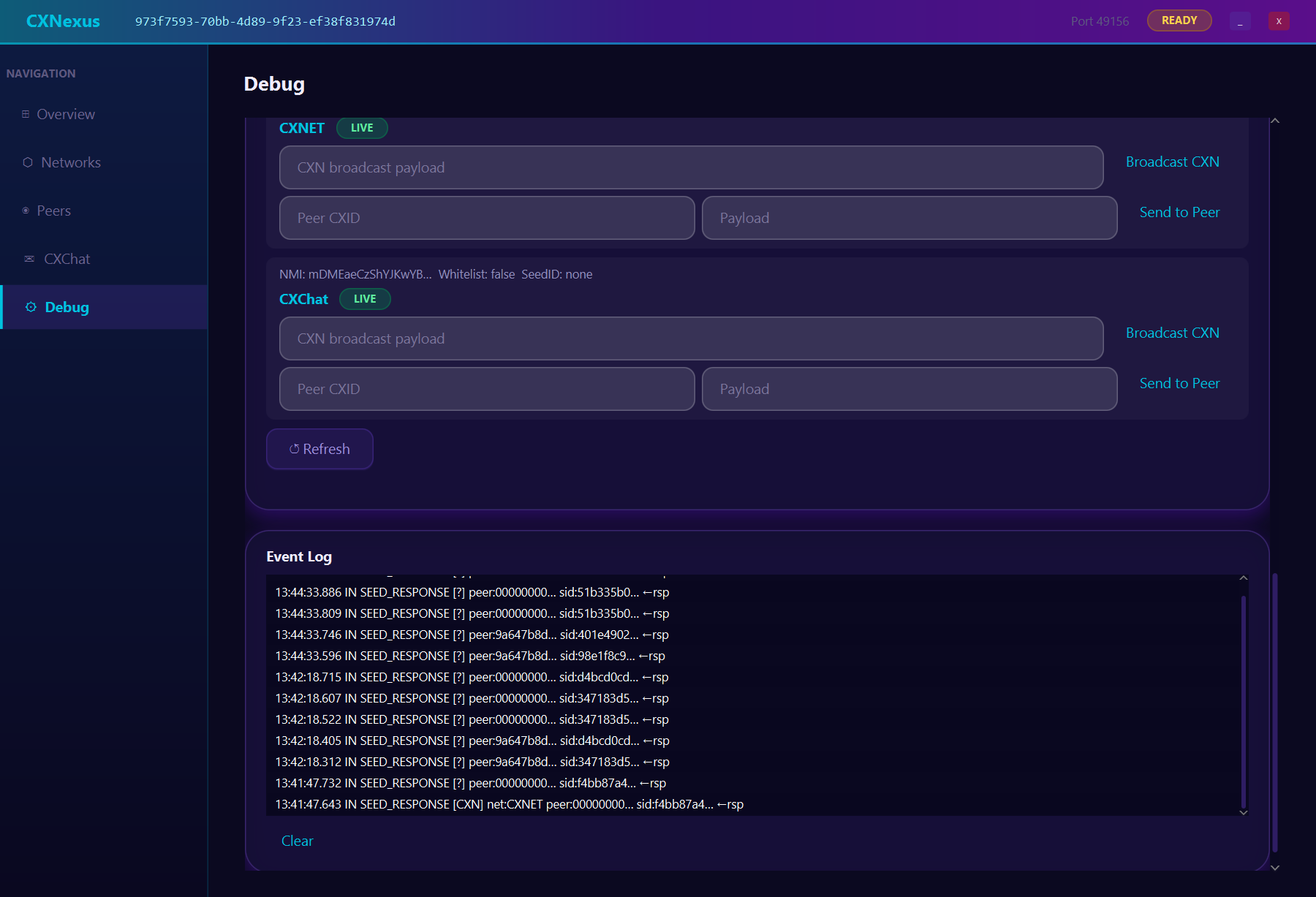
Per-network broadcast and direct send, plus the live event log
Each joined network gets its own live send controls for CXN broadcast and direct peer delivery, and the event log streams inbound and outbound events with their correlation IDs, which is what makes seed exchange traceable end to end.